The Workforce Data Norwegian Aquaculture Companies Are Sitting On
Shift logs, incident reports, sick leave records, and task rotation data already exist in Norwegian aquaculture operations. Most of it sits unused as operational intelligence. AI turns it into early warning signals for workforce health risk before the cost lands on the P&L.
The operational data your aquaculture business already collects contains a pattern most site managers have never been shown.
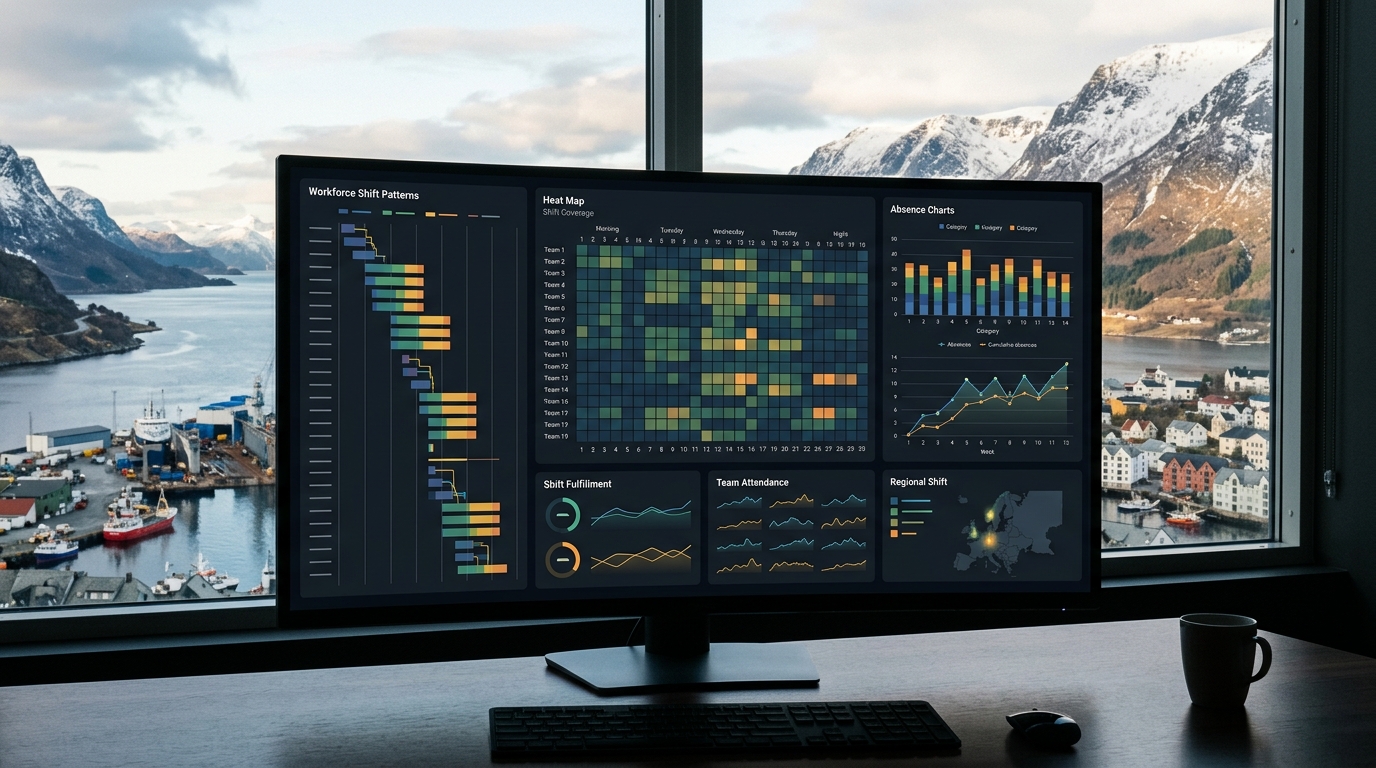
Shift logs document who worked when, for how long, and in what role. Incident reports record near-misses, minor injuries, and the smaller physical events that rarely get investigated beyond the paperwork. Sick leave records capture the downstream outcome of that accumulation. Task rotation schedules, where they exist, show which workers have been absorbing the highest-risk repetitive loads across the longest runs.
Individually, each of those data streams is administrative. Put them together and they describe a workforce health trajectory. The operations that have started using AI to do that aggregation are finding things that shift-level observation and annual health reviews consistently miss.
What the data contains that the operation cannot see
A site manager running three shifts across a 24-hour production cycle cannot hold the full physical load of each worker in their head. That is not a management failure. It is an information density problem. The volume of operational data flowing through a running aquaculture site exceeds what any person can pattern-match in real time.
AI can. The specific use case here is not predictive diagnosis. It is pattern detection across data that already exists.
When shift allocation data shows the same three workers covering the high-grip, cold-floor stations for the majority of hours across six months, that is a load concentration pattern. When incident data from those same workers shows a gradual increase in minor hand and wrist events over the same period, that is a leading indicator. When sick leave data shows the first extended absence from the same region of the body eighteen months later, the outcome has already arrived. The window to intervene closed earlier.
This is the same logic behind the compliance data audit trail and the automated reporting work we have documented elsewhere. The data exists. The gap is a layer of intelligence that reads it as a system rather than as isolated records.
What practical implementation looks like
The starting point is not a complex workforce health platform. The starting point is a structured question applied to data that already exists.
Step one: aggregate your absence data by role, not just by individual. Most absence records are managed at the individual employee level for HR purposes. Aggregated by role and department, they reveal whether the health impact is distributed evenly across the workforce or concentrated in specific operational areas. In aquaculture contexts, cold-floor processing and net-handling roles almost always show higher musculoskeletal absence rates than office-based or logistics coordination roles. If you have not checked that split, you are managing a cost you cannot see clearly.
Step two: cross-reference with task rotation records. The operations that do deliberate task rotation have better health outcomes, lower sickness absence, and lower turnover in physically demanding roles. Not because rotation eliminates the physical load, but because it distributes it across more joints and more workers rather than concentrating it. If your shift data shows low rotation in high-risk roles, that is an operational change with a measurable expected return.
Step three: set up simple exception flagging. You do not need a sophisticated AI platform to start. A structured data pull from your existing systems, set up to flag workers on high-repetition cold-exposure tasks beyond a defined consecutive threshold, gives you a list of names to check in on before the next incident report is written. That is the intervention window. Before the formal absence. Before the injury.
Step four: connect the loop to your physical preparation program. Data detection without an intervention pathway is just documentation. The operations that are making this work have connected the early warning signals from their data to structured physical conditioning support for the workers flagged. When the data identifies a worker in a high-accumulation period, the response is practical: targeted support, task variation, and recovery resources. That connection, from data signal to operational response, is where the financial return lands.
What it costs to not do this
The absence cost, turnover cost, and productivity loss from musculoskeletal conditions in Norwegian aquaculture workforces is significant and well-documented. The less visible cost is earlier than that: the operational degradation that happens before the formal absence, as workers managing cumulative joint pain and fatigue produce at reduced capacity and make more errors.
Aquaculture AI compliance work and visual intelligence on farm are both about getting more intelligence from systems that are already running. Workforce health data works the same way. The data is already there. What is missing is the layer that reads it as a system.
One measured action
Pull the last 12 months of sick leave data from your operation. Sort by job role and department. If musculoskeletal or fatigue-related absence is concentrated in specific roles or shifts, you have identified your first intervention target.
See also
Related notes
The Operational Cost Your P&L Does Not Show: Why Norwegian Aquaculture Leaders Are Treating Workforce Health as a Data Problem
Musculoskeletal absence in Norwegian aquaculture is one of the most consistent and least managed ope…
From Shift Patterns to Safety Risk: Using AI to Get Ahead of Workforce Injury in Norwegian Aquaculture
Musculoskeletal injury in Norwegian aquaculture does not arrive without warning. It leaves traces in…
How Norwegian aquaculture companies are using AI to get ahead of compliance, not just keep up with it
Compliance in Norwegian aquaculture has always been demanding. The companies getting ahead of it are…
Working through a similar challenge?
Start a conversation →